
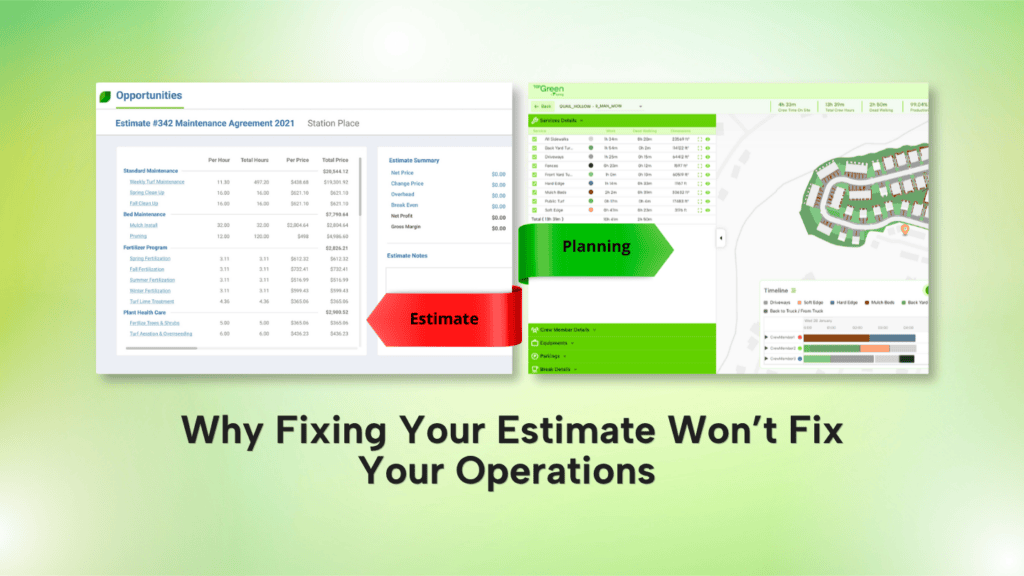
Why Fixing Your Estimate Won’t Fix Your Operations
In the commercial landscaping world, most teams already have the tools; scheduling software, GPS tracking, job tickets, and calendars.
Every one of those tools was built to track work once it’s moving. None of them tell you how the work should run before the week starts.
And yet, once the work hits the field, the same problems keep showing up.
A lot of teams assume the problem comes down to estimating. If the numbers were more accurate, everything else would fall into place.
The assumption is simple. If you could dial in your hours upfront, crews would hit their numbers, routes would run smoother, and margins would take care of themselves.
On paper, that makes sense; but, once the work hits the field, that’s not how it plays out.
Estimating and Planning Are Not the Same Thing
Estimating is how the job gets sold. It sets the hours, the price, and the margin you’re trying to hit.
Planning is what determines whether that job can actually be executed once crews are on site.
An estimate might say a property should take 40 hours a week. But that number alone doesn’t tell a production manager how to run the route, how many crew members to send, or how the work should be broken up across the week.
It gives you a target, but it doesn’t give you a way to hit it.
Most tools in the stack are built to track work once it’s in motion, not to define how it should be run in the first place. That’s where the gap starts.
The Field Doesn’t Run on Averages
Most estimates are built on consistency. The same number of hours, week after week, across the season.
But anyone running crews knows that’s not reality.
One week, a property might take closer to 30 hours. The next week, it might take 45 or more, depending on growth, weather, or what services are needed. Add in call-offs, equipment issues, or a tight schedule, and things shift quickly. That’s where the gap shows up.
Crews either rush to stay within hours or stretch the day to get everything done. Many times, work gets pushed, details get missed, and overtime starts creeping in by the end of the week as crews try to hit their hours.
At that point, you’re not following a plan, you’re reacting.
Planning Is What Turns a Property into a Workable, Profitable Plan
Planning picks up where estimating stops.
Instead of treating the job as one number, it breaks the work down into what actually needs to happen on the property.
Mowing, edging, pruning and detail work, each take a different amount of time. Not every service happens every week, and not every day requires the same crew size or setup. Planning accounts for that.
It helps answer the questions production managers deal with every day:
- How long should this route actually take today?
- How many crew members do I need on this property right now?
- Where am I going to run into overtime?
That’s the difference. It’s not about changing the estimate; it’s about making it practical to execute.
Why This Misunderstanding Causes So Many Problems
When estimating and planning are treated as the same thing, production is left to make the numbers work, regardless of what the field actually looks like.
Production managers are handed a set of hours and expected to hit them, even when conditions change. Crews are judged against those numbers, even when the work doesn’t line up with the estimate.
Over time, that leads to frustration, missed expectations, and constant adjustments just to keep things moving.
Not because the team isn’t capable, but because they’re working off assumptions instead of a clear plan.
The Bottom Line
Estimating tells you what the job should take, including buffers and targets. Planning shows you how to actually run the work based on the scope, crew, and equipment.
Most teams already have the tools to track what’s happening. The question is whether they have a way to define how the work should be run before the week starts or if they’re going to keep adjusting as they go.
That gap isn’t always obvious until you see what running an actual plan looks like.