
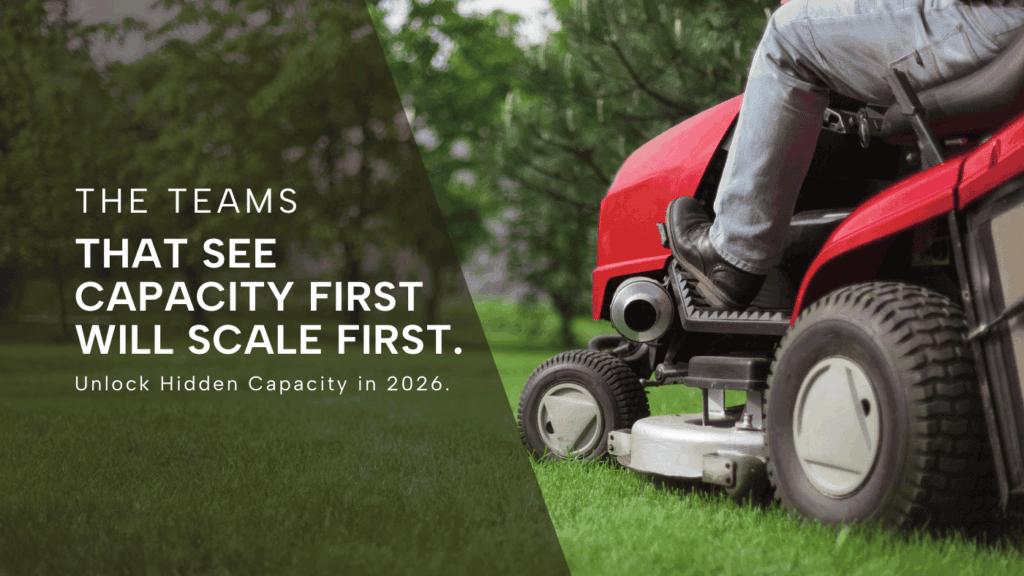
Growth does not start with more crews. It does not start with more equipment. It does not even start with more sales.
It starts with understanding how much capacity your operation can truly support.
That was the lesson of 2025. Not in theory. In practice. Across hundreds of conversations and job plans, the same truth kept surfacing. Landscape companies want to grow, but they are trying to scale on top of systems built from habit, intuition, and inherited assumptions.
That is not a foundation. It becomes a ceiling.
What We Found When We Looked Closer
The constraint was not labor. It was not leads. It was visibility.
Teams were running into limits they could not explain. Routes felt maxed out. Crews felt stretched. But when we looked at the actual work, the planned work, something else emerged.
One operator was sending five crew members alongside autonomous mowers. It was how they had always staffed the job. When we built the plan, it showed that three crew members with two autonomous units could handle the work. They validated it in the field and uncovered two people’s worth of capacity they did not know they had.
Another company was running separate maintenance and detail crews on the same properties. Two visits per site. Five people total across both crews. When we planned it as a combined service, four people could complete everything in a single visit. That was not just labor savings. It was a full crew day they could now apply to new work.
At one site, three mowers were being loaded every visit out of habit. The plan showed two were enough. The job went from 18 hours to 14. Four hours were freed up, not by working harder, but by seeing the work more clearly.
The pattern was consistent. Teams were not short on capacity. They were short on visibility into the capacity they already had.
What This Changed for Us
We entered 2025 thinking about efficiency. We left thinking about growth.
Not because efficiency does not matter. It does. But efficiency is a means, not the message. What operators actually want is room. Room to grow. Room to say yes to new work. Room to scale without the chaos that usually comes with it.
That shift changed how we build, how we communicate, and how we support teams using CrewPlanner. We stopped leading with “eliminate waste” and started leading with “find what is already there.”
Same math. Different motivations. A completely different conversation.
What’s Ahead
2026 is about giving operators the tools to see their own capacity clearly and quickly, without adding complexity to already full workloads.
You will see simpler planning workflows, better visibility into where time is going, and a continued focus on the question growth-minded operators are actually asking: how do I scale without breaking what is already working?
Growth does not require more resources. It requires a truer picture of the resources you already have. That is the work ahead.
The Lesson We’re Taking Forward
2025 taught us that the companies ready to grow are not waiting for permission. They are waiting for visibility.
Every conversation, every branch, and every job plan revealed the same thing. Capacity is not missing. It is hidden. The teams that find it first will be the ones who scale with confidence, even as others chase more labor.
We are entering 2026 with tools, lessons, and a point of view shaped by what the industry showed us this year. The ceiling is not where most people think it is.
Neither is the opportunity.