
Every branch plans.
Schedules get built.
Hours get estimated.
Crews get assigned.
On paper, it looks right.
But paper doesn’t call out sick.
Paper doesn’t quit in April.
Paper doesn’t account for the detail work that spikes in May — or the HOA that suddenly needs weekly service instead of bi-weekly.
Reality does.
And when reality hits, operations owns the outcome.
Why “Good Planning” Breaks in the Field
Most plans are built the same way: Last year’s numbers, Crew intuition, A general sense of how long the job should take, Maybe a buffer — just enough to make the bid work
It’s familiar.
For a long time, it worked well enough.
And in most branches, that planning turns into something very practical:
The perimeter becomes the plan.
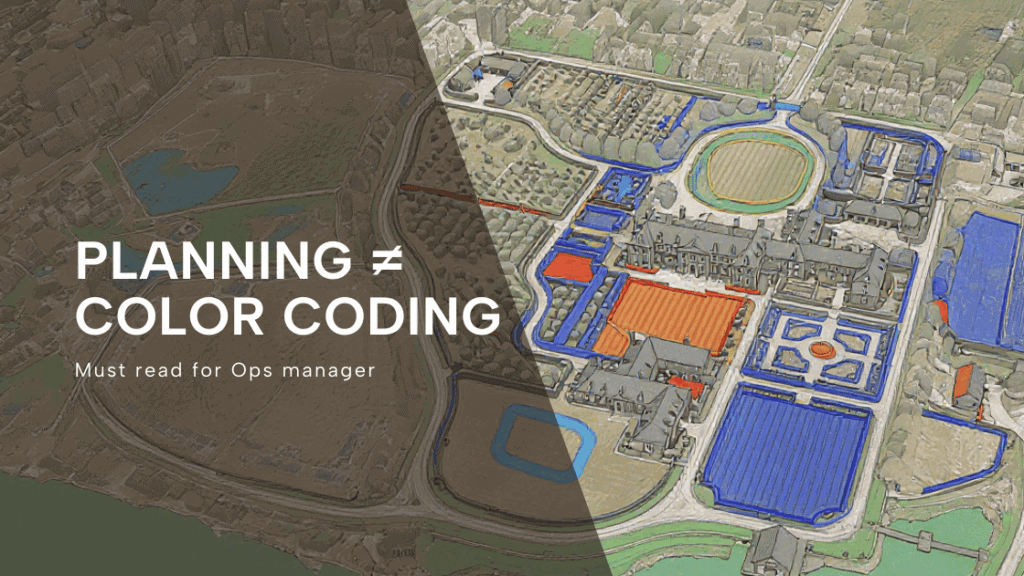
Draw the boundaries. Color-code the sections. Call it “day one, day two, day three.”
Sometimes the “extra detail” is few minutes in PowerPoint — just enough to look clean when it goes to the customer.
Execution runs on repeatable crew logic: 52” up front, 36” around the homes, 60” in the back, Edgers go out at the same time, “Truck parks here. Crew runs this direction.”
That’s not bad Ops.
That’s how maintenance survives at scale.
The problem isn’t the sequence.
The problem is that this plan assumes the day won’t change.
And “well enough” doesn’t survive contact with the season.
Not when:
- Labor costs keep climbing
- Skilled labor availability keeps shrinking
- Your best crew lead takes another offer
- April’s plan collides with May’s chaos
- Detail work doubles and no one re-planned
- Millions in labor hours get approved with no proof they’ll actually hold
At that point, the plan doesn’t fail on paper.
It fails in the field — and lands on you.
Because one question never got answered:
What happens when the day changes?
The Real Problem Ops Managers Live With
Every company has variance and nuance. That’s reality.
The hardest part of planning isn’t effort —
it’s trying to plan for every nuance without a way to test what actually holds.
When the numbers don’t hold, nobody asks how the plan was built.
They ask why it didn’t work.
So Ops managers end up:
- Moving pieces around at 6:30 AM
- Redistributing crews when someone calls out
- Deciding who runs short today
- Absorbing overtime they can’t exceed
That’s not bad execution.
That’s planning without scenarios.
Why CrewPlanner Exists
CrewPlanner wasn’t built for reports.
It wasn’t built for time capture.
It wasn’t built for tracking.
CrewPlanner was built so Ops managers can run “what if” scenarios before the day runs them.
It starts where Ops planning actually starts:
- Serviceable areas
- Sequence
- Equipment mix
- Where the truck parks
- Who does what first
- Shortest routes within the property
- Everyone is equally loaded
Then it lets you test what happens when any of that changes.
CrewPlanner helps you answer:
- What happens if I run this property with fewer people?
- Where does the plan break if someone’s out today?
- How do crew or equipment changes affect hours and efficiency?
Before trucks roll.
Before overtime shows up.
Before you’re explaining numbers that didn’t hold.
A Plan Without Scenarios Is Just Guessing
A single plan assumes: Everyone shows up, Scope stays stable, Productivity holds, Nothing goes wrong.
That’s not planning.
That’s hoping.
Scenario planning doesn’t predict the future.
It prepares you for the situations you already know are coming.
The goal isn’t perfection.
It’s a baseline you can validate — then tighten.
What This Looks Like in the Real World
One branch inherited an HOA plan:
- 6 men
- 48 hours
- “That’s how we’ve always done it.”
They ran scenarios in CrewPlanner instead of executing blindly.
Two stronger options surfaced:
- 42 hours with 4 men at 97% efficiency
- 40 hours with 6 men at 92% efficiency
Same property. Same scope.
Different understanding of what holds — and what breaks.
That’s the shift:
From “we think it takes…”
To “we’ve tested what happens when…”
The Fastest Win Ops Teams Find
A common handoff to Ops looks like this:
“Send 4 guys for 10 days.”
Most teams can make that work.
That doesn’t mean it’s right.
When teams scenario the sections and sequence, they often discover:
- Six guys don’t create speed — they create idle time
- The property should run as five guys most days
That one change can save $1,700*+ per week on a single job.
That’s capacity recovered before the season starts.
Planning That Works During the Day — Not After It
Most Ops managers don’t find problems early.
They find them at the end of the day, when it’s too late to fix.
Scenario-tested planning gives you a baseline to validate against.
Mid-day, you can ask:
- Are we ahead or behind?
- Did the sequence break?
- Did someone drift into tasks they weren’t assigned?
Finding out at 3:30 PM means:
“There’s nothing I can do about it.”
Scenario planning gives Ops managers mid-day control, not end-of-day explanations.
The Branches That Win Will Be Prepared
The branches that win 2026 won’t be the ones with the biggest crews.
They’ll be the ones who:
- Planned during downtime
- Ran scenarios before the season
- Walked in with options, not assumptions
- Knew where the plan would break before it did
Scenario-tested planning won’t be a competitive edge for long.
It will become the minimum standard.
Want to See Where Your Plan Breaks — Before the Season Does?
You don’t need perfect data.
You don’t need to re-plan everything.
You don’t need another system to maintain.
Start with one property — or one day.
Draw the perimeter.
Set the sequence.
Run a scenario in CrewPlanner.
See what actually holds.
One Last Thing
CrewPlanner is scenario planning — future-state “what ifs.”
It’s not time capture.
It’s not tracking.
This conversation is about giving Ops managers control, credibility, and confidence
before the season puts them on the spot.