
You Don’t Have a Labor Problem. You Have a Variability Problem.
Your 40-hour property keeps going to 48.
Every time.
Not because your crews are slow. Not because they’re padding the clock. Because on Tuesday, Miguel called in sick. Wednesday, it rained until noon. Thursday, the client added mulch to three beds you weren’t expecting.
And your production manager is making decisions in real-time with nothing but last year’s overtime reports and a gut feeling.
The Owner Sees One Thing. The Production Manager Lives Another.
From the office, it looks simple: we’re inefficient. There’s waste. If we could just get the crews to follow the plan, we’d save 20, maybe 30 percent.
Easy math.
But your production manager isn’t looking at math. He’s looking at route planning season with 40 properties, six crews, and a truck that keeps breaking down. He’s wondering what happens when Jose—who’s been running the Riverside property for three years—finally quits. He’s padding the schedule because last season taught him that tight budgets mean overtime and angry clients.
He’s not inefficient. He’s prepared for chaos.
And honestly? He’s right to be.
The Problem Isn’t the Waste. It’s That You Can’t Test Anything.
Here’s the real issue: your production manager has no way to answer “what if? ”before it costs you money.
What if I run this property with three guys instead of four?
You Don’t Have a Labor Problem. You Have a Variability Problem. 1
What if I swap the 72-inch mower for two 60s?
What if Miguel takes lead instead of Jose?
What if the client adds edging to the contract mid-season?
Right now, the only way to find out is to try it and see what happens. And “trying it” means risking overtime, blown schedules, and a crew foreman who now doesn’t trust anything you say.
So your production manager doesn’t try it. He sticks with what worked last year. Four guys, 40 hours, pad it to 45 just in case.
The law of averaging is killing you. But it’s the only defense he has.
Where Job Planning Actually Breaks Down
You’ve heard about job scripting. Maybe you even tried it once.
Someone spent three months building detailed plans for every property—park here, mow this section first, edge after lunch, two guys on string trimmers, one on the blower.
Beautiful on paper.
Then the season started.
The crew looked at the plan, nodded politely, and did it their own way. Because they’ve been running this property for three years and they know the gate sticks, the irrigation head is broken in the back corner, and the property manager wants them done before 10 a.m. on Tuesdays.
The plan didn’t account for any of that. So they ignored it.
And your production manager stopped believing in plans.
The Mistake Most Companies Make
They think the problem is execution. Get the crews to follow the plan. Track their time. Measure their movements. Prove there’s waste.
But the crews already know there’s waste. Your production manager knows there’s waste.
Everyone knows.
The problem is: nobody has a safe way to test what happens when you eliminate it.
You Don’t Have a Labor Problem. You Have a Variability Problem. 2
What if you cut the Riverside property from 40 hours to 32? Does the crew actually finish? Or do you blow the schedule, piss off the client, and spend therest of the season firefighting?
You don’t know. And you have no way to find out except the hard way.
What If You Could Test Before the Season Starts?
This is where something changed for a handful of commercial maintenance companies.
They found a way to build job plans without the three-month time suck. More importantly, they found a way to simulate variability before it cost them overtime.
It’s called TOP Green CrewPlanner.
Not tracking software. Not another reporting dashboard. A planning tool that does one thing really well: it lets your production manager answer “what if? ”before route planning season locks in.
Here’s how it works:
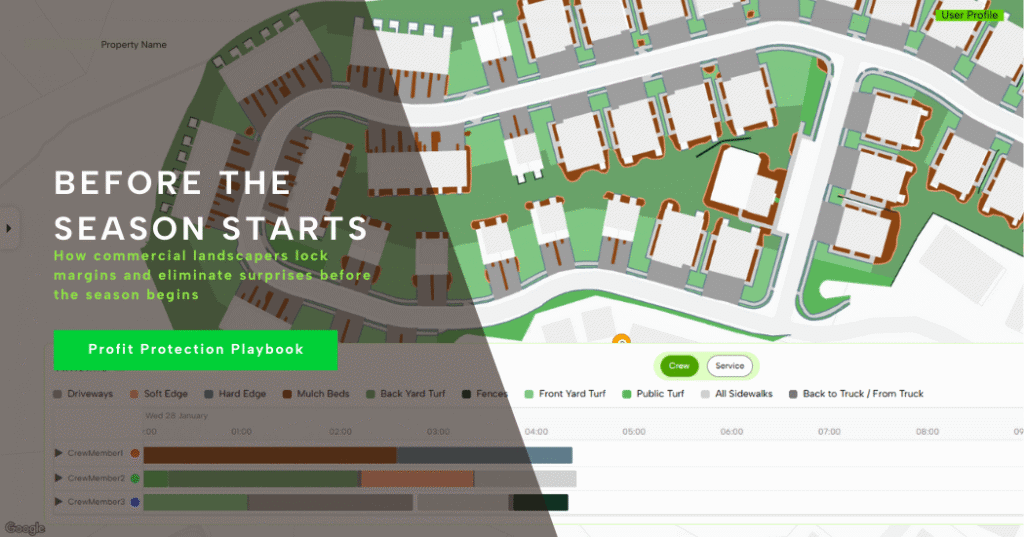
You give it a property map and the services you’re contracted to provide. The system does the takeoffs, evaluates optimised production rates based on actual conditions—including dead walking time, equipment constraints, all of it. Then it builds you a detailed job plan: crew size, equipment needed, time estimates, even a visual map showing where each crew member should focus.
But here’s the part that matters: it’s a sandbox.
Your production manager can test scenarios. Three guys or four? 60-inchmower or 72? What happens if Jose’s not available? What if we swapequipment mid-season?
He can run six different versions of the same property and pick the one that works with his actual constraints. Before he commits. Before he tells the crew foreman anything. Before it costs you a dime in overtime.
And the plans aren’t theoretical. They’re based on real production rates for your geography, your equipment, the way commercial maintenance actually works. Not some consultant’s spreadsheet.
Why This Doesn’t Feel Like Other Software
Because it’s not trying to fix your crews. It’s trying to fix your production manager’s impossible job.
He’s not spending three months manually scripting jobs. The system does that in minutes. He’s not fighting with crews about following some generic plan that doesn’t account for reality. He’s getting a starting point he can adjust based on what he actually knows about the property.
And when something changes mid-season—because it always does—he’s not starting from scratch. He can re-simulate, adjust the plan, and know exactly what the new reality looks like before he sends the crew out.
The companies using it aren’t tracking waste. They’re planning around variability. And they’re recovering 15-20% capacity without asking crews towork faster or adding headcount.
They’re just making better decisions. Before the season starts. Before the chaos hits.
The Uncomfortable Question
How much are you spending because your production manager has to make every resource decision in real-time, with no way to test it first?
Not because he’s bad at his job. Because the only tool he has is experience. And experience is just a record of expensive mistakes.
What if he could simulate the answer instead?
You can’t average your way out of chaos. You can only plan for it.
You Don’t
One Last Thing
CrewPlanner is scenario planning — future-state “what ifs.”
It’s not time capture.
It’s not tracking.
This conversation is about giving Ops managers control, credibility, and confidence
before the season puts them on the spot with right tools to achieve our goals and not excuses…